
1961 & 1966 1983–85
Personal Background: James A. Winger (1922–2007) was born in Ontario and served in the armed forces at the end of World War II . After the war he settled near Hamilton (living in Burlington) and married Lucille; they had two daughters (Roberta and Naomi) and later two grandchildren . Winger was drawn to astronomy early on – a “conversation with a coworker” led him to attend a RASC Hamilton Centre meeting at McMaster University, and he became “immediately hooked” . He built a career as an electronics technician with Westinghouse in the Hamilton area . Throughout his life Winger was known as “Jim” among colleagues, an enthusiastic amateur astronomer and telescope‐maker who exemplified the post‑war boom in Canadian amateur astronomy.
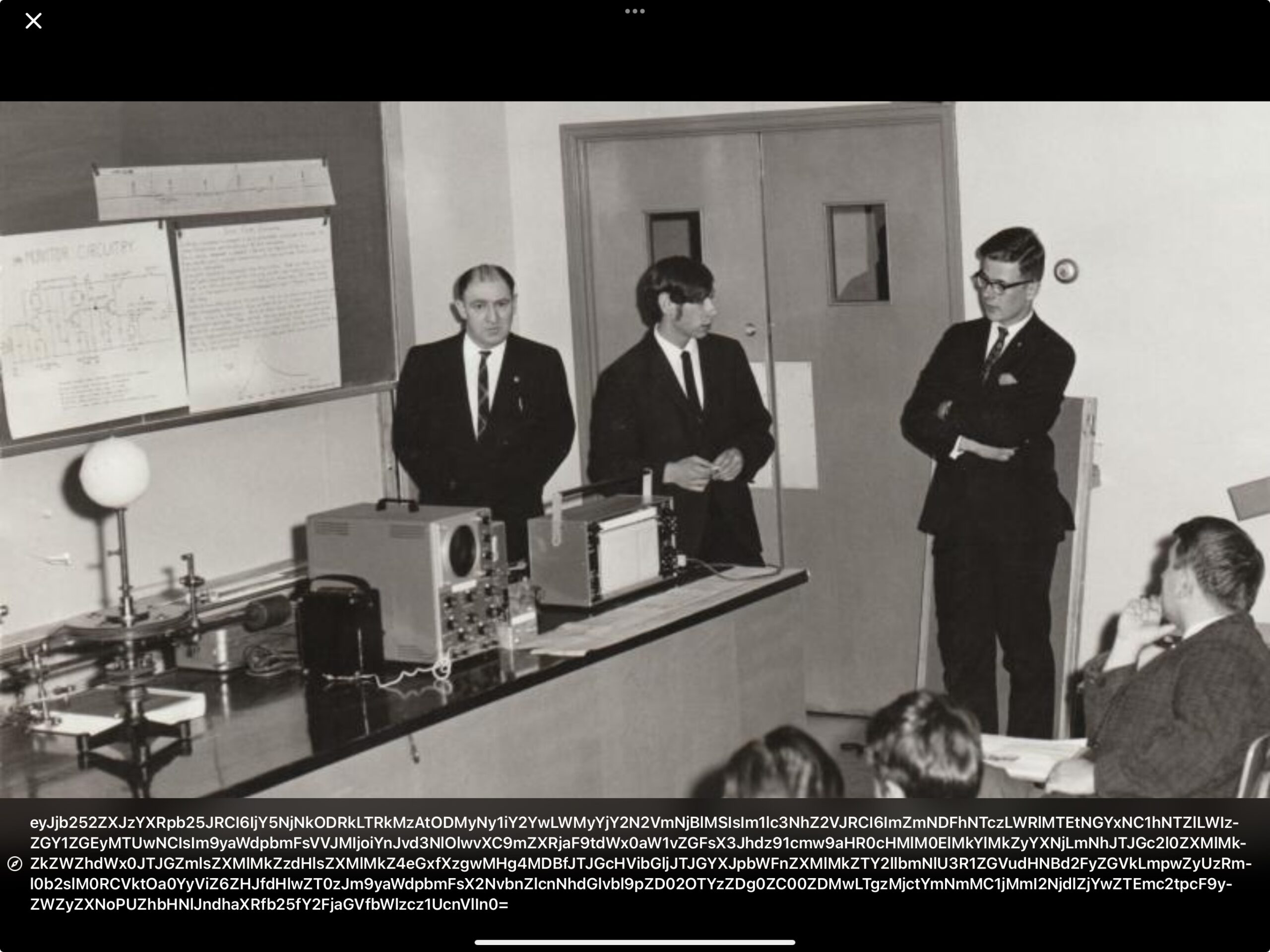
Figure: Jim Winger (circa 1960s), Hamilton Centre president and amateur telescope-maker .
Professional Life: Winger’s technical expertise came from his long career at Westinghouse, where he worked as an electronics technician . He applied those skills to astronomy as well – building his own telescopes and mentoring others in optics work. After leaving the armed forces, Winger immersed himself in science education and outreach. He helped organize science fairs and donated prizes to local youth science competitions. For example, he personally supported the Bay Area Science and Engineering Fair (BASEF) in Hamilton, donating awards to encourage young scientists . His commitment to education and public outreach was a hallmark of his professional and volunteer life.
Joining RASC & Early Activities: Winger joined the Royal Astronomical Society of Canada’s Hamilton Centre in 1952 and quickly became an active member. He was elected to the Centre council in 1956 and soon after led local observing programs. In 1957–58 he and other members organized a visual meteor–watch for the International Geophysical Year (IGY); this effort evolved into the Centre’s long‑running Observers Group . Winger also helped establish an amateur telescope-making (ATM) group. In the late 1950s he volunteered to host regular ATM meetings at his Burlington home, teaching members how to grind mirrors and build telescopes . Over the years he built small refractors and a 6‑inch reflector, and “no one will ever know how many telescopes he’s helped others build” . His home workshop became a training ground: for example, when the old ATM group revived in 1990 he again hosted weekly mirror-grinding sessions in his Caledonia garage, with Lucille welcoming the group with coffee and treats .
Figure: Winger (left) with Hamilton Centre Science Award winners in 1968 . The Centre’s youth‐science awards were among the programs he championed.
Contributions to RASC Hamilton Centre: Winger served multiple terms on Hamilton Centre council and held every senior office. He was elected President in 1961 and again in 1966 (as well as later in the 1980s) . Throughout the 1960s he pushed observational and outreach programs. He co‐founded the Centre’s junior section and regularly brought his two daughters to astronomy events – both Roberta and Naomi were active in the club’s junior star parties by 1968 . Winger also coordinated public‐service projects: he chaired the Centre’s Science Award committee, presenting prizes to school students at science fairs . Under his guidance, the Centre continued its popular field nights and built up its spotting programs. Notably, when the Centre was assisting McMaster University to set up its Spitz projector planetarium, Winger helped construct the makeshift dome (first a parachute, then a cardboard hemisphere) to use with the projector . In short, he helped expand the club’s educational activities and infrastructure.
Hamilton Centre Presidency (1961 & 1966): During his first term (1961) Winger maintained the vibrant post‑war momentum of the club. As Hamilton’s President he oversaw monthly meetings, guest lectures, and public observing sessions (often at McMaster) along the lines of his predecessor’s model. His presidency focused on practical projects: the Observers Group continued systematic meteor and comet watching (at a time when the RASC had launched a national Comet & Nova Section) . In 1966, with Winger again at the helm, Hamilton Centre celebrated its 60th anniversary with a special Orbit newsletter issue highlighting members’ achievements. He also represented the Centre on the national scene – for example as Hamilton’s National Representative – and helped coordinate a successful group expedition to observe a solar eclipse (collecting timing data) . Throughout his presidencies he was known for encouraging hands-on work. He is pictured in 1968 working on the Centre’s new 10‑inch telescope mirror alongside fellow ATMs . His leadership years were characterized by steady growth rather than controversy, building on earlier efforts (as noted by historians) to keep the club “very strong” with “deep interest” in astronomy .
Later Career and Honors: Winger continued to serve Hamilton Centre for decades. He returned as president in the 1980s (1983–85) and remained on council into his later years . In 1984 the RASC awarded him its prestigious Service Award, recognizing his lifetime of volunteer service to the society . He stayed active in the Hamilton Amateur Astronomers (HAA) club (a local offshoot of RASC). In fact, Winger was a founding member of the HAA and remains its only Honorary Chair . He generously supported youth education: the HAA established the James A. Winger Junior and Senior Awards for high-school projects in astronomy, physics or space science . Winger also chaired the Hamilton Centre’s awards committee and personally donated science-fair prizes to encourage student projects .
Legacy: James “Jim” Winger’s legacy is the thriving Hamilton astronomy community he helped build. Colleagues remember him as a skilled observer and telescope-maker, a mentor to younger members, and a tireless promoter of science education . The awards named in his honor at local science fairs ensure his name is linked to inspiring future scientists. He lived to age 84 and passed away in 2007, still remembered as “a long time member of Hamilton Centre and the Hamilton Amateur Astronomers” . His contributions – from organizing the 1950s meteor-watch to leading the Centre in the 1960s and 1980s – are documented in RASC archives and remembrances. As noted by RASC historians, Winger exemplified the postwar generation of amateur astronomers who “built instruments, studied the sky, and shared their knowledge” with the community .
Sources: Archival RASC documents and newsletters, including the Encyclopedia Uranica, Hamilton Centre Orbit newsletters, and historical accounts , as cited above. The figures above come from RASC’s digital archives and publications, respectively .