
J. Gordon Craig: A Leader in Canadian Amateur Astronomy
Background and Early Involvement in Astronomy
J. Gordon “Gord” Craig was a prominent Canadian amateur astronomer who played a leading role in the Royal Astronomical Society of Canada’s Hamilton Centre during the mid-20th century. A science graduate (B.Sc.) by education, Craig joined the Hamilton Centre of the RASC in 1951 and quickly became an active member . He was elected to the Centre’s Council in 1953, indicating his early commitment to the society’s activities . By the mid-1950s Craig was a key participant in the Centre’s flourishing post-war astronomy scene, which included regular meetings, public lectures, observing nights, and telescope-making workshops . Notably, Hamilton Centre members around this time built a large homemade reflecting telescope (featured in the Hamilton Spectator in 1956) and even established a small observatory on a member’s property . Craig was among the collaborators in these ambitious projects , reflecting the hands-on, skill-sharing ethos of the club. An historical account by long-time member H. B. Fox credits the “aggressive” Centre executives of the 1950s (Craig among them) for making the Hamilton Centre “very strong” and fostering a “deep interest” in astronomy among its members .
Craig also distinguished himself as a knowledgeable speaker and educator in astronomy. Even before he assumed any presidency, he was delivering talks to his fellow members on advanced topics. For example, in February 1957 the Hamilton Centre heard a lecture on “the speed of light” presented by J. Gordon Craig (then a rising member, noted as a future president) . Such contributions underscored Craig’s reputation for scientific enthusiasm and helped inspire the membership with current astronomy research. In addition to his RASC involvement, Craig pursued observational astronomy in broader circles – he became a member of the American Association of Variable Star Observers (AAVSO) and the British Astronomical Association (BAA), connecting him with international amateur-professional networks . He himself owned and used a 4-inch refractor and an 8-inch reflector telescope , tools with which he conducted observations (including variable star and meteor work) and mentored others in the craft of observing. This rich background set the stage for Craig’s leadership roles in the RASC and the local astronomy community.
First Term as RASC Hamilton Centre President (1958–1959)
In late 1957, J. Gordon Craig was elected President of the RASC’s Hamilton Centre, and he served in that capacity through 1958 and 1959 . (At the time, the Hamilton Centre typically rotated its presidency annually or biannually among dedicated members.) Succeeding earlier post-war leaders such as O. J. “Pat” Paton and W. J. “Bill” Sled, Craig took the helm of a Centre that was vibrant and growing. Under his guidance, the Hamilton Centre continued the momentum of the 1950s: programs remained strong and membership engagement was high. Monthly meetings at McMaster University and elsewhere featured diverse guest speakers, and the Centre maintained special interest sub-groups for telescope making, variable star observing, astrophotography, and even exploratory forays into the new field of radio astronomy . Craig’s leadership style was collegial and hands-on, emphasizing both the scientific and social aspects of the club. He chaired meetings, guided the executive council, and represented Hamilton at the RASC National Council . There were no crises during his term; rather, the Centre was described as “vibrant and growing,” carrying on its mission smoothly under Craig’s steady direction .
One highlight around Craig’s first term was the Hamilton Centre’s increasing prominence within the national RASC. In fact, in March 1958 (around the start of his presidency) Hamilton hosted the RASC’s Annual Meeting – the first time this national gathering was ever held outside of Toronto . The event featured a dinner at McMaster’s Refectory followed by a keynote lecture on globular star clusters by the renowned Dr. Helen Sawyer Hogg . As Centre President (or President-elect) at that time, Craig was deeply involved in this milestone event, coordinating with the National Council and local organizers. The successful 1958 meeting was a point of pride for the Hamilton Centre and attested to the momentum the Centre had gained under the leaders of the 1950s . Craig’s term in 1958–59 built on this success, reinforcing Hamilton’s reputation as one of the RASC’s most active centres.
Within the Hamilton Centre, Craig fostered an inclusive, collaborative spirit. Senior members like Craig mentored newcomers, and many took turns in various officer roles – a tradition that kept the Centre dynamic. During Craig’s tenure, the Centre continued to encourage practical astronomy projects. Telescope-making efforts remained in full swing (members were grinding mirrors and constructing instruments), and the club’s first homemade large reflector – completed just before his term – was being put to use. The Hamilton Spectator photograph from 1956 mentioned earlier captures the atmosphere: in that image, then-President Bill Sled stands among colleagues (including a young Gord Craig) celebrating their newly built telescope . Craig’s own presidency carried this spirit forward, as he supported the Telescope Makers Group and other initiatives to ensure the Centre was not just meeting for lectures but also doing astronomy. He likewise encouraged public outreach activities that had begun in the 1950s – for example, the Centre operated a small planetarium projector donated in 1949, which was used for public astronomy shows in the community. It is likely that in 1958–59 Craig oversaw continuing planetarium demonstrations for local schools and youth groups, reflecting his interest in education and outreach. By the end of his first term (late 1959), the Hamilton Centre was thriving, and Craig had left the presidency in capable shape for his successors. He did not step away from astronomy, however, and would return to lead the Centre again a few years later.
Continued Contributions Between Presidencies (1960–1965)
After 1959, J. Gordon Craig remained an influential figure in the Hamilton Centre and the broader astronomy community. He served for several years as the Centre’s Director of Observations (from 1961 through 1966) , a role in which he coordinated the observing programs and encouraged members’ scientific projects. In this capacity, Craig organized observing teams and reporting routines for phenomena like meteors, comets, and variable stars. In fact, Craig had a particular interest in meteor astronomy – by the late 1960s he was leading the Centre’s Meteor Observing Group . Under his watch, Hamilton members regularly conducted meteor watches (the spectacular Leonid meteor storm of November 1966, for instance, would have been observed by local teams Craig helped organize). Craig’s involvement with the AAVSO also meant he was contributing variable star observations to international databases, demonstrating citizen science in action. The AAVSO Reports of the early 1960s list “J. G. Craig, Canada” among the observers, with dozens of variable star estimates to his credit in a given year . These activities kept the Hamilton Centre closely tied to professional-amateur collaborations and maintained its members’ enthusiasm.
Craig also served on the RASC National Council as one of Hamilton Centre’s representatives in this period. For example, in 1965 and 1966 he was often the Centre’s National Council delegate, helping shape RASC policies and exchanging ideas with other Centres . Locally, he remained a fixture at meetings and club events. He was known to step up as a speaker when needed – whether giving a technical talk on electromagnetism or leading informal discussion groups. Society records from 1965 show Craig co-hosting an exchange lecture on “Electromagnetic Radiations” for the Centre . He also contributed to the Hamilton Centre’s newsletter (aptly titled Orbit), which kept members informed and connected. By the mid-1960s, Craig was widely respected as a veteran member with deep knowledge and a welcoming attitude toward newcomers. This respect is evident from the fact that in late 1966 the membership once again elected him as Centre President – calling him out of “retirement” to serve a second term at the helm.
Second Term as President (1966–1967) and Centennial Initiatives
Craig’s second tenure as President of RASC Hamilton Centre spanned 1966–67, a period marked by both the society’s own growth and the excitement of Canada’s Centennial celebrations. At the Centre’s annual meeting on January 5, 1967, President J. G. Craig delivered a rousing President’s Address titled “Why Astronomy?” – a talk that articulated the value and purpose of astronomical pursuits. In this address, Craig likely reflected on the progress of the space age (with Apollo Moon missions on the horizon) and challenged members to consider astronomy’s significance to society and to themselves. His leadership in 1967 emphasized engaging the public and expanding the Centre’s capabilities.
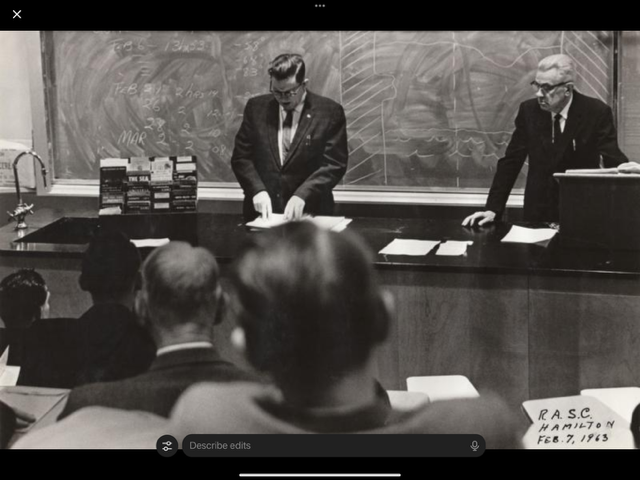
Community Outreach and Youth Engagement: The Hamilton Centre was extremely active in outreach during Craig’s 1967 presidency. According to the Centre’s annual report, members organized no fewer than six major public demonstration events that year . These included astronomy displays at the Burlington Centennial Fair in May 1967, “field nights” at local Boy Scout and Cub Scout camps during the summer, a special Centennial open-house night at McMaster University (September 1967) where telescopes were set up for the public, and an astronomy lecture-and-telescope session at a Hamilton school . Such events introduced hundreds of people to astronomy during Canada’s Centennial. Craig was a strong proponent of youth involvement; under his tenure the Centre ran an active Junior Club with monthly junior meetings . In fact, Craig’s own son Douglas was a leading member of the juniors – he served as “Junior President” and led a discussion on spaceship command modules at one 1967 youth meeting . By empowering younger enthusiasts and collaborating with groups like Scouts and schools, Craig helped nurture the next generation of astronomers. The atmosphere at Hamilton Centre gatherings was collegial – one archived photograph from a meeting on February 7, 1963, for instance, shows J. Gordon Craig (at left) briefing members on viewing times for Comet Ikeya, while the Centre’s then-President Ed Ostrosser looks on . This image illustrates Craig’s long-standing role as an educator within the club, even when he wasn’t president.
A 1963 RASC Hamilton Centre meeting where J. Gordon Craig (left) provides viewing predictions for Comet Ikeya as Centre President Ed Ostrosser (right) looks on . Craig was a key source of astronomical knowledge at club meetings throughout the 1960s, even when not serving as President.
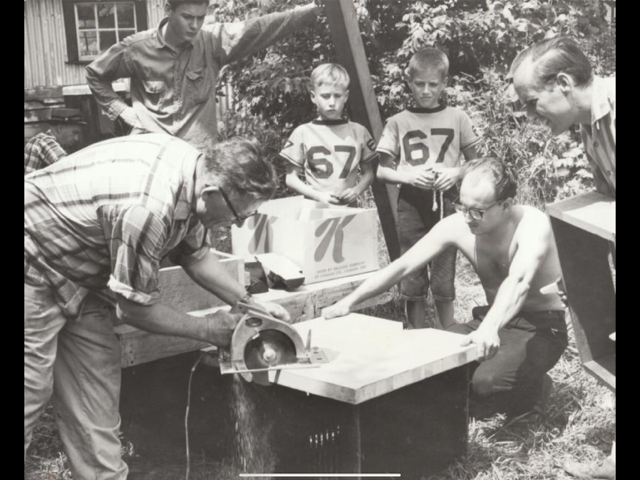
Telescope Project and Observatory Plans: Perhaps the crowning initiative of Craig’s 1966–67 term was the construction of a new 10-inch reflecting telescope for the Hamilton Centre. The amateur Telescope Makers Group, which had been meeting every two weeks in member workshops since the early 1960s, focused their efforts on building this large $f/8$ Newtonian reflector . Virtually all components of the telescope were made by hand by club volunteers – from grinding and polishing the 10-inch mirror to fabricating the mounting. A crucial step took place in mid-1967: the casting of the telescope’s heavy equatorial mount. In July 1967, Craig offered his own farm in Lynden, Ontario as the site to perform an aluminum casting for the mount – a dramatic, foundry-like operation involving melting down scrap aluminum in a homemade furnace. The casting session was a team effort and a testament to Craig’s practical leadership. As described in the Centre’s archives, “Aluminum casting for mounting the Hamilton Centre’s 10-inch telescope [took place] at the Craig Farm at Lynden, Ontario in July 1967.” Craig himself is documented as being hands-on during the process, operating a saw in the preparation of the mold, alongside other members and even his son.
Hamilton Centre members casting the aluminum mounting for their new 10-inch telescope at J. Gordon Craig’s farm in Lynden, Ontario (July 1967) . Gord Craig (bending at center, operating the saw) offered his property and labor for this ambitious DIY project. This collaborative effort exemplified the spirit of the Centre during Craig’s presidency.
By the end of 1967, the 10-inch telescope was nearly complete – the optics finished and the mount cast – awaiting only its drive mechanism . This project, initiated and seen through under Craig’s leadership, significantly upgraded the Centre’s observing equipment. It was also a point of pride that galvanized members’ enthusiasm. Along with the optical telescope, some members (such as A. G. “Tony” Freeth and R. McCallum) experimented with building a radio telescope receiver in 1967, managing to detect solar radio noise and even signals from satellites like ESSA and Nimbus . Craig’s openness to such new ideas (dating back to the radio astronomy interest in the 1950s) helped diversify the Centre’s activities. Clearly, by the late 1960s, the Hamilton Centre was pursuing astronomy on multiple fronts – optical observation, astrophotography, radio observation – and Craig’s inclusive leadership encouraged this exploration.
Administratively, Craig’s 1966–67 term saw the Hamilton Centre continue to thrive. Four Centre council meetings and eight general meetings were held in 1967, in addition to eight junior meetings – a hefty schedule indicating robust participation. The Centre’s membership was strong and inter-generational. Craig ensured smooth operations and also represented the Centre at the RASC General Assembly. In 1967, he was part of the RASC’s national executive as well: notably, the Society’s President that year was Dr. Malcolm Thomson, but Craig’s experience was undoubtedly valued in national discussions. When Craig’s term concluded in October 1967 (with the election of a new Centre President at the Annual Meeting) , the Hamilton Centre was well-prepared to move into the new era. The late 1960s efforts that he spearheaded – especially the completion of the 10-inch “Club Telescope” – laid the groundwork for the Centre’s next big step: establishing a permanent observatory.
Contributions to the RASC and Broader Scientific Community
Beyond his formal terms as president, J. Gordon Craig made lasting contributions to the RASC and amateur astronomy. As described, he was instrumental in organizing observational programs within the Hamilton Centre, serving as Director of Observations for five years. In this role he coordinated regular observing sessions and data submissions, essentially acting as a bridge between the amateur observers and scientific results. For instance, variable star observations by Craig and his colleagues would be forwarded to the AAVSO, contributing to real research on stellar variability. Craig’s membership in the AAVSO and BAA connected Hamilton’s amateurs to international networks – he kept up with global astronomy news and techniques, and brought that knowledge home. It’s worth noting that Craig was part of the generation of amateur astronomers who embraced scientific rigor in their hobby; they carefully logged observations, built reliable instruments, and even published their findings. While we have no evidence of Craig authoring research papers himself, his name does appear in observational report listings, and he gave numerous presentations to share knowledge. For example, Craig prepared a comprehensive talk on “Astronomy in Hamilton” for a special program (likely marking the Centre’s 60th anniversary in 1969), where he recounted the history of astronomy in the city and the Centre’s development . Such presentations and write-ups helped document local scientific heritage. Craig also wrote articles and notes for the RASC’s internal publications. The RASC Hamilton Centre’s newsletter Orbit often featured Craig’s updates or observational highlights. In one 1969 special issue of Orbit, Craig is listed as the Centre’s Curator, with a brief biography detailing his long service . This profile lauds his multiple stints as President, his years as Observations Director, and his leadership of the meteor group, painting a picture of a “renaissance” amateur astronomer who engaged in all aspects of the club’s life .
Craig’s contributions also extend to the archival record of Canadian astronomy. Photographs and minutes from mid-century RASC activities frequently show his involvement. The RASC’s National Archives and the Hamilton Centre archives preserve images like the ones included above, as well as logbooks and correspondence where Craig’s name appears. These historical documents highlight the human side of scientific organizations – enthusiasts like Craig who volunteered time and expertise to build communities of knowledge. In the Hamilton Centre’s 60th anniversary booklet (titled “Sixty Years in Orbit”), Craig and his contemporaries are repeatedly mentioned as driving forces behind the Centre’s accomplishments . He lived through a transformative era in astronomy (from the dawn of the space age into the Apollo era) and ensured that his local society remained not only active but forward-looking.
Legacy and Recognition
J. Gordon Craig’s legacy is most evident in the continued strength of the Hamilton Centre and its resources. The momentum from the 1960s – to which Craig greatly contributed – culminated in the Hamilton Centre establishing its own permanent Observatory in 1974 . This observatory, with multiple telescope facilities, became the heart of the Centre’s activities and has served generations of stargazers since . It stands in part as a legacy of the telescope-building culture that Craig fostered. Fittingly, one of the observatory’s buildings is named the Leslie V. Powis Building (after another of Craig’s contemporaries), underscoring how the efforts of that era’s members are honored by those who follow. While Craig himself did not become a household name in professional astronomy, within the RASC community he is remembered as a devoted volunteer and leader. Longtime members of the Hamilton Centre recall his friendly mentorship and his passion for observing. The fact that he was called back to serve as President twice, nearly a decade apart, speaks to the high regard in which he was held by his peers.
It does not appear that Craig received formal national awards (such as the RASC Service Award) during his lifetime, but his impact was primarily at the Centre level. The Hamilton Centre’s archives and historical essays ensure that his contributions are not forgotten. For instance, recent historical retrospectives (like profiles of past presidents) explicitly mention Craig’s accomplishments, cementing his place in the Centre’s story . Through these records we learn that Craig’s approach combined practical skills (building telescopes, organizing observations) with enthusiastic outreach and leadership. In an era before computer automation, he calculated comet viewing times and meteor rates by hand, sharing that knowledge with the public. He bridged the gap between amateur fun and scientific contribution, embodying the RASC’s mission of “Inspiring interest and knowledge of astronomy”.
In summary, J. Gordon Craig’s background in science and his love of the night sky made him an influential figure in Canadian amateur astronomy. He twice led the RASC Hamilton Centre – in 1959 and 1967 – guiding it through periods of growth and innovation. During those terms, he oversaw notable initiatives like the first national RASC meeting outside Toronto, the construction of a 10-inch club telescope, and extensive Centennial-era public outreach. In the years between and after, he remained a pillar of the Centre through various roles (Observations Director, curator, councilor) and participated in the broader scientific community via organizations like AAVSO and BAA. His story is preserved in the annals of the RASC as an example of dedicated volunteer leadership. By all accounts, J. Gordon Craig helped ensure that the “aggressive enthusiasm” of the 1950s and 60s Hamilton Centre translated into a lasting legacy – a thriving astronomical society with its own observatory, active programs, and a spirit of exploration that continues to this day .
Sources: Historical archives and publications of the Royal Astronomical Society of Canada, including the RASC Hamilton Centre’s Sixty Years in Orbit special issue (1969) , RASC Annual Reports from the 1960s , and the Hamilton Centre’s digital archives (meeting photographs and narratives) . These records detail Craig’s tenure and contributions, corroborated by contemporary accounts in the Hamilton Spectator and AAVSO reports . The Hamilton Centre’s historical articles (e.g. on W. J. Sled) also provide context for Craig’s era , while current RASC Hamilton resources acknowledge the long-term fruits of his and others’ labors (the establishment of the Hamilton Centre Observatory in 1974) . Through these sources, J. Gordon Craig emerges as a foundational figure in the RASC Hamilton Centre and a respected contributor to Canada’s amateur astronomy heritage.