
A Mission in the Shadow of Mariner 4
In the mid-1960s, the race to explore Mars intensified. Just two days after NASA launched Mariner 4 on its historic flyby, the Soviet Union responded with Zond 2, a Mars-bound interplanetary spacecraft designed to advance planetary science and bolster Soviet prestige in the space race.
- Launch Date: November 30, 1964
- Launch Vehicle: Molniya 8K78
- Launch Site: Baikonur Cosmodrome, Kazakhstan
- Mission Type: Mars flyby
- Operator: OKB-1 (Soviet Space Program)
Goals and Instrumentation
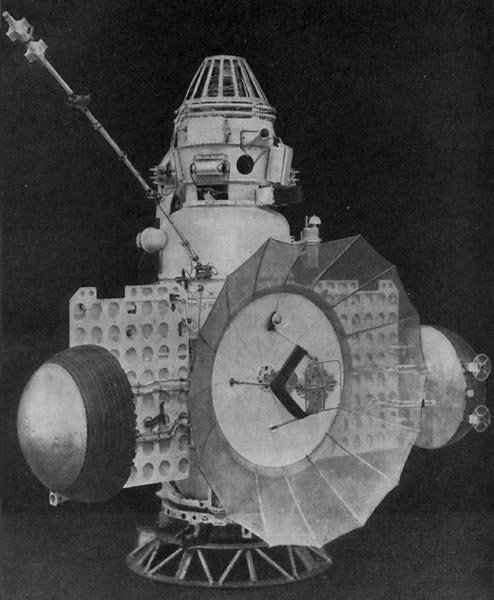
Zond 2 was part of the USSR’s ambitious Mars program and was equipped with an impressive suite of scientific instruments:
- Ultraviolet spectrometer – for analyzing the composition of Mars’ upper atmosphere
- Infrared radiometer – to study Martian surface temperature
- Gas-discharge counters – to detect charged particles
- Magnetometer – to assess Mars’ magnetic field
- Solar and cosmic ray detectors
- Imaging system – similar to previous Soviet probes (though low resolution by today’s standards)
Zond 2 was also notable for carrying the first-ever pulsed plasma thrusters in space, an experimental propulsion system tested during the cruise phase.
What Happened?
Initial flight operations were nominal. The spacecraft performed a successful mid-course correction in early 1965, using one of the plasma thrusters. However, by May of that year, Zond 2’s radio transmitter failed, cutting off all communication. The spacecraft silently flew past Mars in August 1965, around the same time Mariner 4 was returning the first-ever close-up images of the Martian surface.
Outcome and Legacy
While Zond 2 did not return scientific data, it was a vital part of the Soviet interplanetary program. The mission:
- Demonstrated complex course correction techniques
- Tested new propulsion technologies
- Paved the way for Mars 2 and Mars 3 (1971), the first successful missions to reach the Martian surface (though brief)
Zond 2’s story reflects the high-stakes innovation of early planetary exploration—a time when every mission was a first, and every failure was a stepping stone toward success.